
 87% of our restaurant clients renew their contract.
The industry average is closer to 30%.
Restaurant owners don’t extend contracts out of loyalty. They cycle through agencies fast – usually 2 to 3 in the first few years.
We’ve had clients stay with us for 5+ years because the work we do keeps moving the client’s business; more bookings, fuller tables, and increased genuine enquiries.
Since 2019, we’ve worked with 150+ restaurants across Dubai and Abu Dhabi.
Cafés, cloud kitchens, QSRs, Premium-casual, casual dining and multi-location franchises.
This guide is our restaurant marketing strategy – what we’ve learned about what actually works.
Whether you’re opening your first restaurant or wondering why your current marketing isn’t working, read on to find out how Team Donut will approach your marketing.
What Needs to Be Ready Before You Spend on Marketing?
Before hiring an agency, running ads, or paying influencers – three things need to be in place. These are the foundations that make everything else work.

Google Business Profile
When someone searches “breakfast near me” or “Italian restaurant JBR,” Google Maps is where they decide. This is a high-intent discovery – people are ready to eat right now.
What to check:
- Primary and secondary categories match what you serve
- Hours, menu link, and contact info are accurate and complete
- Photos are recent, well-lit, and show the actual experience
- Reviews are being responded to regularly (Google rewards activity)
- Posts and updates go up weekly, not just at launch
For Denny’s, “breakfast” wasn’t even appearing as a search trigger at some locations when we started. Six months of consistent local SEO & optimization for their restaurants: breakfast searches at Al Manara went up from 269 to 2,692. Full breakdown here.
Social Media and Brand Presence
Your Instagram is often the first impression. Someone checks your page before visiting – they’re looking for proof that you’re worth the trip.
What to check:
- Visual direction is consistent and matches your positioning (premium restaurant should look premium)
- Bio communicates who you’re for and what you’re known for
- Content gives a clear sense of the experience, not just the food
Nayaab Haandi had three Dubai locations, premium pricing, quality food – but their social media didn’t reflect that. We worked on repositioning first, content second. 8.5K to 20K followers in 15 months. Restaurant at full capacity with weekend waiting lists.
Delivery App Listings
Talabat, Deliveroo, Noon Food – each platform has its own algorithm. Strong Instagram content doesn’t automatically translate here.
What to check:
- Product photos are clear, appetizing, and sized for small thumbnails
- Descriptions give customers a reason to choose you (not just item names)
- Menu structure makes sense – logical categories, smart combos, anchored pricing
- Ratings are actively managed (a 4.3 vs 4.7 dramatically affects visibility)
Macanudas serves empanadas – a product most UAE customers don’t immediately recognize. Someone scrolling Talabat sees a closed pastry and has no idea what’s inside or how big it is. That uncertainty kills conversions.
We changed the photography. Cut the product open so customers could see the filling. Placed it next to a familiar size reference so they understood what they were ordering.
Then restructured the menu – clearer categories, smarter combos, pricing that made sense against competitors.
Conversion rate went from 5% to 25%. Overall sales up 25%.
Small changes to how the product was presented. No new menu items. No discounts. Just removing the friction that stopped people from ordering.
What Does a Restaurant Launch Look Like?
A launch is a campaign, not an announcement. It starts weeks before doors open and continues after.
One thing we’ve noticed across launches: the customers who stick around are usually the ones closest to you. Not the people who drove 30 minutes because they saw an influencer – the ones who live in the building next door or work down the street.
The office crowd
A coffee shop opening in Dubai Silicon Oasis came to us with a quote from another agency. AED 45,000 for the standard launch package – influencers, paid ads, campaign management.
That playbook makes sense in destination areas – Marina, Downtown, JBR, etc.
But Dubai Silicon Oasis isn’t a dining destination. It’s office parks and apartment buildings. People don’t drive there to discover a new café – they work there, and they need coffee before their 9am meeting.
The opportunity wasn’t getting foodies to visit once. It was becoming the daily habit for the thousands of people already within walking distance.
We skipped the influencer blitz. Built a hyperlocal strategy instead – content that spoke to the morning commute, targeting that focused on the immediate radius.
400+ customers in week one. Zero ad spend. And more importantly, repeat customers from day one.
The neighborhood
Desi Deli launched in Karama – a neighborhood where customers know exactly what things should cost.
The restaurant had great interiors, noticeably better than most spots in the area. But interiors alone don’t fill tables. The real draw was the price point on specific items – quality food at prices that made sense for Karama.
We worked with influencers who already covered the area. Creators known for highlighting deals and hidden gems, not luxury dining. People whose audiences actually live and eat in Karama.
The positioning matched the neighborhood. Not “premium Indian cuisine” – quality at a great price.
Now when the owners sit in the restaurant and ask customers how they found the place, the answer is almost always the same. An Instagram reel. A TikTok creator. The launch content is still working months later.
What ties these together
Launch strategy depends on where you are and who’s around you. A Business Bay fine dining spot needs a different approach than a Karama neighborhood restaurant or a DSO coffee shop.
The goal isn’t maximum reach. It’s reaching the people most likely to come back.
What Does Ongoing Marketing Actually Include?
Once your restaurant is running and people know you exist, marketing shifts. It’s no longer about awareness. It’s about solving revenue problems.
Finding the hidden opportunity
Estabena had great dinners and packed weekends. But the mornings were quiet.
After a year working together – including a Ramadan buffet campaign that delivered strong results at low cost – we looked at the data. Morning slots had low footfall. And existing customers didn’t even know Estabena served breakfast.
The growth opportunity wasn’t new customers. It was a time slot hiding in plain sight.
We shot scroll-stopping breakfast content – UGC reels, premium visuals, real morning energy. Then ran targeted lead gen ads designed to start conversations.
455+ conversations from a single ad. Cost per lead: AED 7. Breakfast became a revenue driver.
Cracking consistency

Nayaab Haandi hit 20K followers. Weekend waiting lists. The awareness problem was solved.
Now the work is different. We identified what consistently performs on their account – specific hooks, pacing, visual style – and built a repeatable system around it. Same storytelling structure. Same energy. Adjusted for each new campaign.
Instagram rewards consistency. Not just posting frequency – consistency in what works. When you crack the pattern, you repeat it. The algorithm starts working for you instead of against you.
From there, lead gen ads convert the warm audience into buffet bookings and delivery orders. Content keeps the brand positioned. Ads drive revenue.
When marketing isn’t the problem
Industry data shows 70% of first-time diners never come back. If your return rate is worse than that, more ads won’t fix it.
That’s an operations problem – food, service, experience. Pouring money into visibility when people aren’t returning is waste.
The restaurants that grow understand when to push marketing harder and when to pause and fix something else first.
How Do You Scale Across Multiple Locations?
Single location marketing is tactical. Fill slow hours. Drive conversions. Solve specific revenue problems.
Multi-location or Franchise Restaurant Marketing is different. The math changes.
When you have one café in JLT, reaching people in Sharjah doesn’t help much – they’re not making that trip for coffee. But when you have locations across the city, broad reach actually converts. Someone sees your content in Jumeirah, remembers the brand, and walks into your Al Jada, Sharjah branch a week later.
This is when going viral starts to matter.
Engineering a viral product
Caffe Di Roma has over 50 locations across the UAE. We’d already had success with their Cheesecake on a Stick campaign. For winter, the brief was to repeat that momentum.
Hot chocolate was trending – but every café in Dubai sells hot chocolate. The challenge wasn’t the product. It was making the same product remarkable.
We partnered with a Dubai-based influencer to co-create the drink at the café. Not a paid post – collaborative product development. After multiple iterations, a plain Italian hot chocolate became The Snowman: a snowman stick figure perched on top, a meringue bed to keep it afloat, a custom winter-themed cup sleeve.
The launch followed a teaser strategy. Week one: mysterious snowman content with no drink visible. Comments flooded in asking what it was. Week two: full reveal with making-of videos and POV content.
14 million impressions. Followers grew from 7K to 12K in six weeks. Hot chocolate sales went from 7-10 cups a day to 40-50 consistently. And because Caffe Di Roma had locations everywhere, that attention resulting from a viral campaign converted across the city.
The touchpoints beyond content
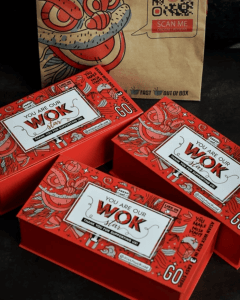
Asian Wok had six branches. Content and campaigns were running. But multi-location marketing isn’t just about reach.
We designed custom gift boxes for customers who had ordered more than 100 times in the past year. A small gesture – but one that rewards loyalty at scale. These went to top customers, to influencers, to area managers at each location.
When you’re running multiple branches, consistency in content matters. But so do the details that make customers feel remembered. Marketing at this stage isn’t just about visibility. It’s about reinforcing the relationship at every touchpoint.
The math
Viral reach without multi-location presence is a spike that fades. Viral reach with locations everywhere is sustained revenue.
We built this system for Denny’s UAE across 5 branches in Dubai and Abu Dhabi. See how it worked.